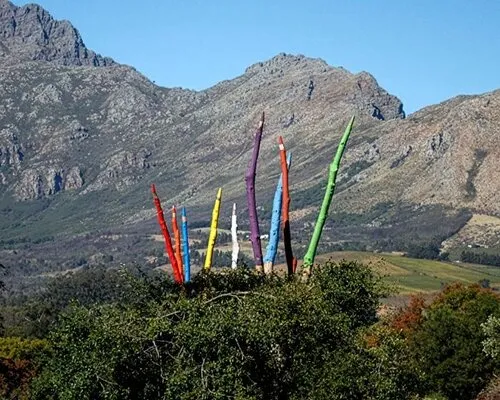
Imagine walking through a grove and discovering that the trees have been sculpted and painted to look like enormous colored pencils, their tapered tips pointing skyward. That's exactly the experience waiting for visitors to Strijdom van der Merwe's striking new land art installation in South Africa, where 24 living trees have been transformed into one of the most recognizable objects of childhood creativity.
Art growing from the ground up
Van der Merwe is no stranger to working with the natural world - his practice consistently explores the tension between human intervention and living environments. But this project feels particularly layered. By choosing colored pencils as his form, he's created an almost paradoxical image: tools of artistic creation, realized through the act of reshaping nature itself.
The sheer scale of the work is part of what makes it so compelling. These aren't props or painted sculptures placed among trees. They are the trees, carefully shaped into familiar cylindrical forms complete with the tapered, pointed tip that gives a pencil its identity. Seeing something so ordinary rendered enormous - and alive - has a way of stopping you in your tracks.
Why land art still matters
Land art has been asking difficult questions about human relationships with the environment since the late 1960s, and this installation sits comfortably in that tradition while feeling completely fresh. There's something genuinely thought-provoking about using living trees as your medium. Unlike a canvas or a block of marble, these trees continue to grow and change. The work is never quite finished.
Van der Merwe's choice to examine intervention within a living environment is particularly resonant right now. We're all increasingly aware of how human activity reshapes the natural world, and art that holds that tension up for examination - without lecturing you about it - tends to hit differently than a documentary or a news headline ever could.
The magic is in the contrast
Part of what makes the installation so visually arresting, as reported by Designboom, is the contrast between the vibrant, almost cartoonish colors of the pencil forms and the organic, textured reality of living wood and bark. It's playful and a little surreal, but it's also asking you to sit with some genuinely interesting questions about creativity, nature, and what we consider acceptable when it comes to reshaping the world around us.
Whether you read it as a celebration of human creativity or a meditation on our complicated relationship with natural spaces - or both - this is the kind of work that sticks with you long after you've scrolled past the images.