
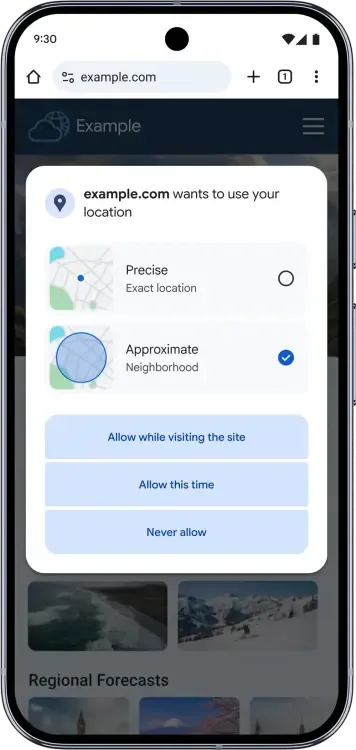
If you've ever felt a little uneasy handing over your precise location to every website that asks for it, Google has finally done something about it. Chrome for Android has quietly rolled out a feature that lets you share an approximate location with websites rather than your exact coordinates - and it's the kind of privacy upgrade that actually matters in everyday life.
What's actually changing
Until now, Android users on Chrome faced a binary choice: share your pinpoint location with a site, or share nothing at all. The new option adds a middle ground. When a website requests your location, you can now choose to give it a rough sense of where you are - think neighborhood or city level - without handing over the precise GPS coordinates that could reveal your home address, your workplace, or your daily routine.
This kind of approximate location sharing has been available on iPhone for a while, so Android users catching up is genuinely welcome news. As Lifehacker reports, the feature is now live for Chrome on Android.
Why this is a bigger deal than it sounds
Location data is one of the most sensitive categories of personal information out there. Even when you trust a website's intentions, you rarely know who else has access to the data it collects, or how long it's stored. A weather app or a local restaurant finder doesn't need to know your exact address - it just needs to know roughly where you are. Approximate location is more than enough for most everyday use cases.

There's also the question of data breaches and third-party trackers. The less precise the information you share, the less useful it is to anyone trying to build a profile of your movements or habits. Giving out your approximate location instead of your exact one is a simple habit that quietly reduces your exposure over time.
How to use it
When a website prompts Chrome to access your location, look for the option to share an approximate location rather than a precise one before you grant permission. It's a small extra step, but worth making a habit - especially for sites you don't visit regularly or don't fully trust.
Privacy improvements don't always come with fanfare, and this one flew under the radar for most users. But small, practical controls like this are exactly what meaningful digital privacy looks like. It's not about going off the grid - it's about sharing only what's actually necessary. And now, on Chrome for Android, you finally have that choice.