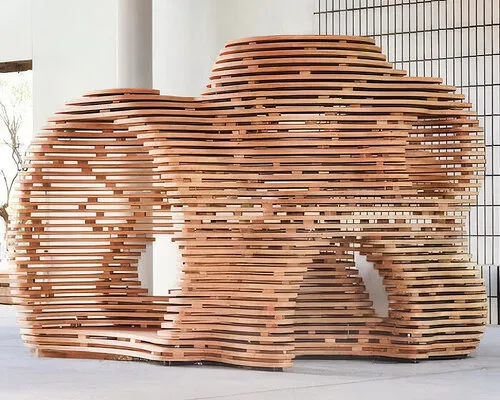
What if a traditional Japanese architectural element walked into a CNC router factory and came out the other side as a stunning public gathering space? That's basically what happened here, and we're not mad about it.
Designers have reimagined the engawa - the classic transitional corridor or veranda space found in traditional Japanese buildings - as a digitally fabricated timber installation made for public use. Reported by Designboom, the project uses CNC-routed plywood components to build out its signature stepped geometry, turning what is essentially a centuries-old architectural idea into something that looks like it belongs on the cover of a design magazine (and also, somehow, at your local park).
Wait, what even is an engawa?
Fair question. The engawa is that liminal strip of space you find running along the edge of a traditional Japanese house - not quite inside, not quite outside, but deeply intentional. It's the architectural equivalent of "let's hang out but keep it casual." Historically, it served as a buffer zone between private life and the outside world, a place to sit, observe, think, and maybe sip tea while judging your neighbor's garden.
It is, in short, one of the most underrated spatial inventions in human history. And someone finally decided to scale it up for the masses.
CNC routers doing the lord's work
The magic here is in the method. CNC routing allows for precision cutting of plywood components that would be nightmarishly complex to produce by hand. The result is a stepped, modular structure that carries the spirit of the engawa's layered, in-between quality while feeling undeniably contemporary.
The stepped geometry isn't just a visual choice - it creates natural seating levels, gathering spots, and informal zones that encourage people to linger. Which is very much the whole point of the engawa philosophy: slow down, hang around, exist somewhere between here and there.
Why this actually matters
Public spaces have a chronic problem with being either aggressively functional (here is a bench, sit on it, leave) or weirdly hostile to actual human use. This installation leans hard into a different tradition - one that treats transitional space as valuable in itself, not just as a means to get from A to B.
Bringing a concept like the engawa into contemporary public design feels less like cultural borrowing and more like rediscovering something we collectively forgot: that the best spaces aren't rooms, they're thresholds.
Also it looks extremely cool, which never hurts.