If you've ever wished golden hour could last all day, a Portuguese design studio might have just made that dream a reality - at least in one very special corner of Portugal.
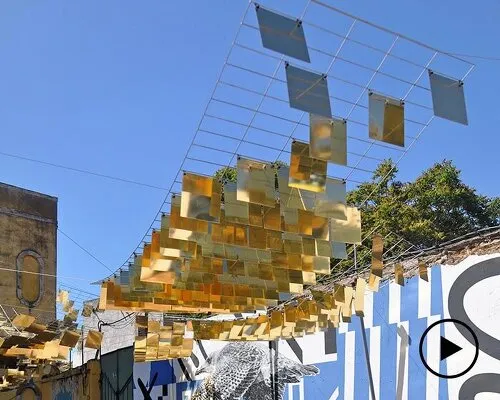
Creative studio Moradavaga has unveiled A-L-M-A-D-R-A-V-A, a stunning kinetic installation that transforms a rundown former beer factory into a living, breathing spectacle of light and movement. And the effect? Something that looks uncannily like a shoal of golden fish catching the sun as they move through water.
Where kinetic art meets pixel art
The installation sits at an unexpected crossroads - part kinetic sculpture, part pixel art. Hundreds of small mirrored elements are arranged in a grid-like formation, each one catching and redirecting light as air moves through the space. The result is a constantly shifting mosaic of gold and reflection that animates the industrial shell around it in ways that feel almost alive.
According to Designboom, the concept draws directly from the almadraba - the ancient Mediterranean tuna fishing technique that involves a labyrinth of nets guiding fish toward the surface, where their scales flash brilliantly in the sunlight. That visual memory, of a writhing, glittering mass of fish, is exactly what this installation channels.
Why a derelict factory makes the perfect canvas
There's something particularly satisfying about the choice of location here. Abandoned industrial spaces have a rough, forgotten quality that makes the intrusion of something this beautiful feel almost surreal. The contrast between the worn concrete and weathered brick and the constant shimmer of reflected gold doesn't just work - it amplifies everything.
Moradavaga has always been drawn to spaces like this, where art can breathe new life into places that might otherwise sit ignored. The former brewery becomes a kind of stage, with the installation as its endlessly shifting performer.
Art that responds to the world around it
What makes A-L-M-A-D-R-A-V-A genuinely compelling beyond the visual wow factor is its responsiveness. Kinetic art lives and dies by how it interacts with its environment - wind, light, the movement of visitors nearby. This installation doesn't just sit there looking pretty; it reacts, flickers, and transforms depending on conditions around it.
In a cultural moment where so much visual art is designed for a single perfect Instagram frame, there's something refreshing about work that resists being frozen. You simply have to be there, in that space, to experience it properly - and that feels like exactly the point.