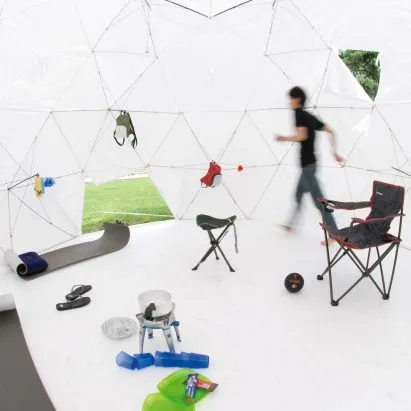
If you thought architecture was mostly just glass boxes competing to see who can look the most soulless, Kengo Kuma is here to absolutely ruin that assumption for you - in the best possible way.
The legendary Japanese architect, best known as something of a high priest of wooden buildings, has just released a new book called Substance, published with The Images Publishing Group. And while wood is very much still on the menu, Kuma uses the book to flex way beyond his signature material, spotlighting six projects that span everything from paper to bamboo.
Wait, paper? Like, actual paper?
Yes. Paper. The stuff you doodle on during meetings. Kuma is out here building with it, and apparently pulling it off with what he describes as a "humane and beautiful" approach to materials. That phrase alone should make every glass-and-steel developer feel at least a little called out.
The premise of Substance is genuinely compelling: instead of organizing his portfolio by geography or typology, Kuma frames his work through the lens of materials themselves. It's a nerdy, tactile, deeply intentional way of looking at architecture - and honestly, it makes you wonder why more architects don't think this way.
Why this actually matters
We're living through a moment where the architecture world is slowly, painfully reckoning with sustainability. Concrete and steel are brutally carbon-intensive. Glass towers are essentially giant heat lamps. So an architect of Kuma's stature making a very public case for materials like bamboo and paper isn't just aesthetically interesting - it's a quiet form of industry provocation.
Kuma has long been the guy who makes buildings feel like they belong to their landscape rather than having crash-landed on it. His work tends to breathe. It tends to age. It tends to feel like something a human being actually wants to be near, which is a shockingly low bar that a lot of contemporary architecture still manages to miss.
The book as manifesto
Substance, as reported by Dezeen, reads less like a portfolio flex and more like a quiet argument. The argument being: the material IS the message. What a building is made of shapes how it feels, how it ages, how it connects people to place. In an era of renderings that all look identical, that's a pretty radical position.
Whether you're an architecture obsessive or just someone who's tired of ugly buildings making you feel vaguely depressed, Substance seems like the kind of book that reminds you good design is still very much alive - it's just usually made of something unexpected.