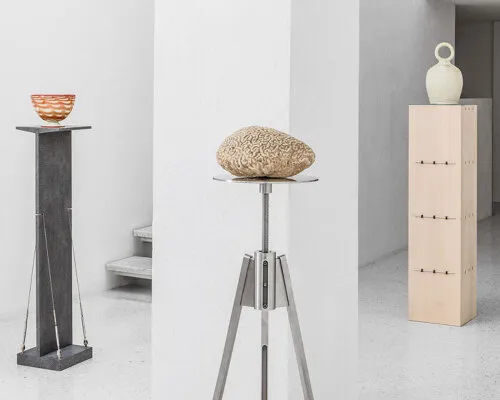
Somewhere in the history of design, pedestals got absolutely railroaded. They became the anonymous sidekick, the unsung roadie carrying the rock star onstage before shuffling back into the dark. Francesco Faccin, bless him, has decided that era is over.
The Italian designer's latest investigation - reported by Designboom - zeroes in on the architecture of display itself. Using steel, pyrex, and wood, Faccin has transformed the humble support structure into the sculptural protagonist of its own story. The pedestal isn't holding something anymore. It IS something.
Why this is a bigger deal than it sounds
Think about every gallery you've ever walked through. You probably clocked the painting, the sculpture, the ceramic bowl that cost more than your rent. You almost certainly did not stop and think, 'wow, what a fascinating base.' That invisible quality is exactly what Faccin is interrogating here, and it's a genuinely clever design provocation.
When you remove the assumed hierarchy between object and support, you're basically pulling the tablecloth out from under decades of display convention. What was infrastructure becomes composition. What was background becomes foreground. It's the design equivalent of suddenly noticing the negative space in a logo and never being able to unsee it.
The materials are doing serious heavy lifting
The choice of steel, pyrex, and wood isn't arbitrary. These are materials with wildly different personalities - industrial versus scientific versus organic - and pairing them in support structures forces you to think about weight, transparency, and presence in ways a traditional plinth never would. A pyrex element, for instance, is simultaneously there and not there. It supports while disappearing. That's a philosophical statement wearing a very elegant disguise.
Faccin's work sits in that satisfying design sweet spot where the concept is genuinely interesting but the objects themselves are also just... beautiful. You don't need to read the theory to appreciate that something unusual and considered is happening.
The overlooked object as design territory
There's a whole tradition of designers finding rich territory in the things everyone else ignores - the back of a chair, the underside of a table, the hinge on a cabinet door. Faccin is firmly in that lineage here. Pedestals are everywhere in cultural spaces, doing essential structural work while being almost aggressively overlooked.
Giving them the spotlight isn't just a fun conceptual flip. It's a reminder that the frame matters as much as the picture, that context shapes meaning, and that the stuff we treat as invisible infrastructure deserves a second, much slower look.
Also, these things just look genuinely cool, which never hurts.