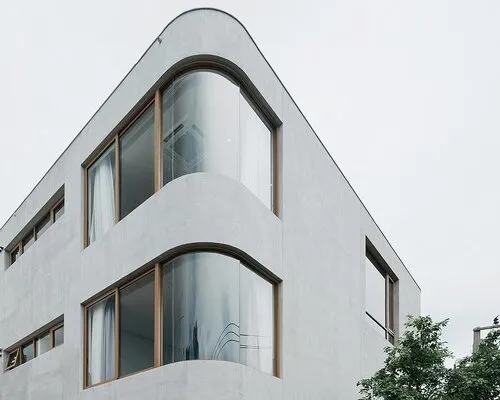
If you've ever tried to extend an existing home without making the addition feel like a clumsy afterthought, you'll appreciate just how tricky that balancing act can be. A newly completed project in Bangkok - the OOM House extension by Anonym Studio - offers one of the more elegant solutions to that problem we've seen in a while.
Curves doing the heavy lifting
Rather than defaulting to the sharp angles and flat planes that dominate most contemporary architecture, the designers leaned into continuous curves as their central organizing idea. According to reporting by Designboom, the extension uses curved concrete volumes that interlock through a glass hinge - a transparent connector that acts as a visual breathing space between the original structure and the new addition.
It's a smart move. The glass hinge keeps the two parts in conversation without forcing them to merge awkwardly. Light flows through, the boundary between old and new stays legible, and the whole composition feels intentional rather than improvised.
Inside out, outside in
What makes the project particularly cohesive is how the curved logic applies to both the interior and exterior surfaces simultaneously. The continuous curves aren't just a facade treatment - they carry through into the interior spaces, aligning the two into what the designers describe as a unified system.
This kind of consistency is harder to achieve than it sounds. It means the experience of moving through the space feels connected to how the building reads from the street, which is often where residential extensions fall apart. You get a dramatic exterior and then walk inside to find something completely disconnected.
Why Bangkok, why now?
Bangkok has quietly become one of the more exciting cities for experimental residential architecture in Southeast Asia. A younger generation of local and internationally trained architects is pushing against the cookie-cutter tropical modernism that dominated Thai residential design for decades, and projects like the OOM House extension are a great example of that shift.
Concrete as a material also makes particular sense in this context - it handles the tropical climate well, ages interestingly, and allows for the kind of sculptural freedom that timber or steel framing often can't match at this scale.
The takeaway
The OOM House extension is a reminder that adding to an existing home doesn't have to mean compromise. With a clear conceptual move - here, the interlocking curves and the glass connector - you can create something that feels genuinely considered rather than merely functional. It's the kind of project that makes you think differently about what domestic architecture can do.