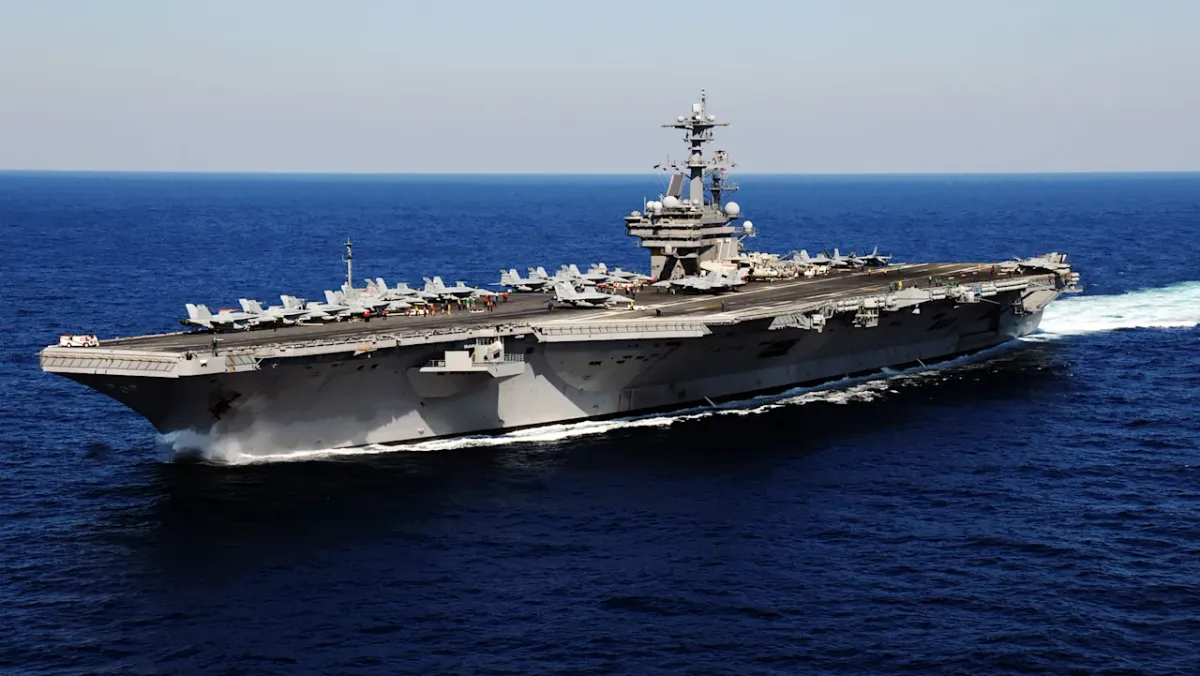
Laser weapons have long lived in the realm of science fiction and "almost there" military announcements. But a recent test by the U.S. Navy suggests the technology is finally moving from promise to reality - and the setting was one of the most iconic vessels in the American fleet.
The USS George HW Bush, a Nimitz-class aircraft carrier, successfully shot down multiple drones using a high-energy laser weapon mounted on its flight deck during a live-fire test in October 2025, according to reporting by Fast Company. The Navy only recently revealed the milestone publicly, releasing photos through the Defense Visual Information Distribution Service that show the 20-kilowatt system in action.
Why a carrier makes sense
At first glance, strapping a laser to one of the world's largest warships seems almost obvious. Aircraft carriers are enormous, which means they have the space to house bulky directed-energy systems that smaller ships simply couldn't accommodate. They also generate massive amounts of onboard power - a persistent challenge for laser weapons, which are notoriously energy-hungry. On a carrier, that power problem becomes far more manageable.
There's also a practical threat picture to consider. Carriers are high-value targets, and drone swarms represent one of the more unsettling modern threats to naval operations. A laser that can quietly and cheaply neutralize incoming drones - without burning through expensive missiles - is an attractive defensive layer for a ship that costs billions to build and operate.
But it's not all smooth sailing
The carrier environment also brings real complications. Flight decks are chaotic, high-traffic spaces where aircraft, crew, and equipment are constantly in motion. Integrating a directed-energy weapon into that environment without creating new safety risks is genuinely difficult. Heat, salt air, and the physical demands of carrier operations can all degrade sensitive optical systems faster than engineers would like.
There's also the question of what happens when the laser needs to operate in poor weather. Fog, rain, and sea spray can scatter or weaken a laser beam significantly - conditions that carriers regularly sail through.
A stepping stone, not a final answer
Still, the test represents meaningful progress. U.S. Navy leaders have spoken openly about wanting a laser on every ship, and proving the concept works on a carrier - one of the most demanding environments imaginable - builds the case for broader deployment. If the technology can handle a Nimitz-class flight deck, scaling it to other vessels starts to look a lot more achievable.
For now, the George HW Bush test stands as a quietly historic moment: the first time a carrier has used a laser weapon to destroy targets in a live-fire scenario. It won't make headlines the way a fighter jet launch does, but in the long arc of naval warfare, it might matter just as much.