You know how every tech company eventually builds a campus that looks like a rejected prop from a sci-fi movie? Well, Tencent just won that competition - and it's not even close.
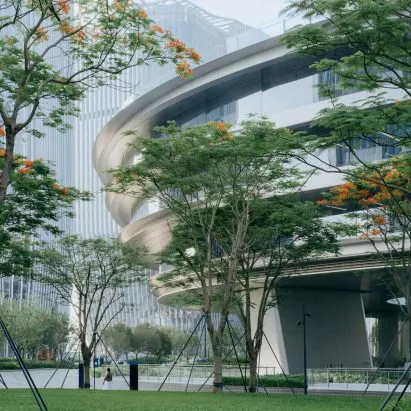
Architecture studio MAD has completed the Tengyun Center in Shenzhen, a 72,000-square-metre complex built as part of Tencent's sprawling 80-hectare headquarters across the Qianhai and Da Chan Bay areas. The result is three enormous curved, glazed volumes - officially nicknamed "cloud buildings" - that float between two office towers like architectural marshmallows caught mid-drift.
What exactly are we looking at here?
The three interconnected structures aren't just pretty faces (or pretty clouds, rather). According to Dezeen, the volumes house offices and event spaces, all wrapped in glazed facades that give the whole thing that signature "did gravity forget about us?" vibe that MAD has become known for.
MAD, for the uninitiated, is the Beijing-based studio that has spent the better part of two decades building things that look physically impossible - and somehow keep getting clients brave enough to let them do it. Tencent, one of the world's largest tech companies, apparently said "yes, give us the clouds" and here we are.
Why this actually matters beyond looking cool
It's easy to dismiss this as billionaire tech architecture cosplay, but there's something genuinely interesting happening here. The decision to break a massive corporate campus into softer, curved forms - rather than the usual glass-box grid - signals a shift in how tech giants want to present themselves. Less "we control the servers," more "we flow like nature, we are harmony, please don't regulate us."
Cynicism aside, the Tengyun Center represents a serious architectural statement. Interconnected volumes that bridge between towers create a campus that actually encourages movement and interaction between spaces - something a lot of corporate architecture spectacularly fails at while claiming to do the opposite.
The verdict
Is the Tengyun Center a little over the top? Absolutely. Is it the kind of building that will appear in architecture students' mood boards for the next decade? Without question. Does Tencent now have the most extra corporate campus in a country full of extremely extra corporate campuses? Almost certainly yes.
Sometimes "absurd" and "brilliant" are the same building. This might be one of those times.