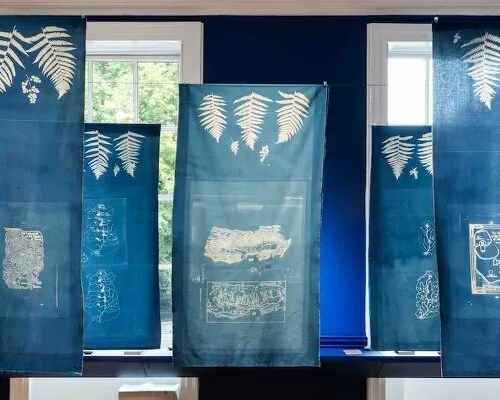
What happens when you take a science fiction visionary's personal map collection and turn it into a meditation on human consciousness? You get something genuinely rare - an exhibition that refuses to sit still in any single category.
The Word for World is doing exactly that. Drawing on Ursula K. Le Guin's lifelong fascination with cartography, the show uses her collection of maps as a jumping-off point for something far more ambitious: a deep dive into how we draw the boundaries of reality itself, according to designboom.
Why Le Guin and maps make perfect sense
If you know Le Guin's work - the sprawling, politically charged worlds of the Hainish Cycle, the intricate societies of Earthsea - her interest in maps tracks completely. She spent her career building places that felt geographically and emotionally real, worlds where the landscape was never just backdrop but always meaning.
A map, after all, is never neutral. Every cartographic choice - what to include, what to leave out, where to place the center - is an act of storytelling. Le Guin understood this instinctively, and the exhibition leans into that idea hard.
Redrawing the boundaries of perception
What makes The Word for World compelling beyond the Le Guin fandom is its existential ambition. This isn't a straightforward archive show. It uses cartography as a lens for asking bigger questions - about myth, about dreams, about the limits of what human perception can actually chart.
There's something quietly radical about that framing. We live in an era of near-perfect GPS coverage and satellite imaging, yet so much of inner experience remains stubbornly unmappable. Dreams, grief, memory, imagination - none of these respond well to coordinates.
Le Guin spent decades writing in that unmappable territory, and the show seems to honor that by inviting viewers to sit with the same productive uncertainty her fiction always generated.
Why this matters right now
There's a reason exhibitions like this resonate in 2024. Amid constant information overload and the pressure to optimize every corner of life, the idea of deliberately stepping into the uncharted feels almost countercultural.
Le Guin's cartographies - both literal and metaphorical - offer a different kind of orientation. Not the comfort of knowing exactly where you are, but the richer experience of staying curious about where you might be.
For anyone interested in the intersection of art, literature, and the way we construct meaning, this is the kind of show worth seeking out.