
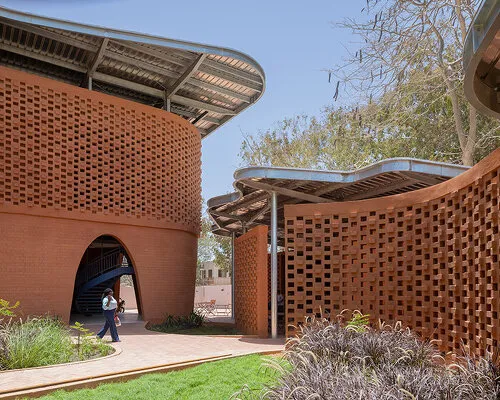
After decades of the Goethe-Institut operating out of adapted, repurposed spaces around the world, someone finally said "enough" and called the one architect who could actually do it justice. Francis Kéré - the Pritzker Prize-winning architect who has spent a career proving that earth, community, and climate-smart design are not consolation prizes but the real deal - has just unveiled the organization's first purpose-built home in Dakar, Senegal.
Let that sink in. The Goethe-Institut, one of the most globally active cultural organizations on the planet, has been operating for decades without a single building designed specifically for it. That streak is now gloriously over.
Earth, shade, and actually thinking about the climate
Kéré Architecture's approach to the Dakar project is deeply site-specific, which in this context means the building doesn't just sit in Senegal - it genuinely belongs there. Built using earth-based construction methods, the design draws on the kind of climate intelligence that has kept West African architecture cool and functional for centuries, long before anyone invented air conditioning and started pretending that was progress.
The building is designed around public life and exchange - not just as a nice marketing phrase, but as an actual spatial logic. Learning, gathering, and cultural encounter are baked into the layout, which is exactly what you want from a cultural hub that's supposed to do more than look good in architectural magazines (though it absolutely does that too).
Why this actually matters
There's a bigger story here beyond aesthetics. Kéré is an architect from Burkina Faso who studied in Berlin, and the Goethe-Institut is Germany's primary vehicle for international cultural exchange. That this meeting point now has a physical home in Dakar - a city that has long been a creative and intellectual powerhouse on the African continent - is not a small thing.
It's architecture as a genuine act of cultural investment, not a symbolic gesture. And because Kéré built it with earth rather than imported glass and steel, it also quietly makes the point that the materials and knowledge systems already present in a place are often all you actually need.
Dakar has always deserved something like this. Now it has it. According to Designboom, the project represents a real milestone for the organization - and honestly, for what thoughtful architecture can mean when it's given the right brief and the right hands.