Here's a wild idea: what if the problem with AI for scientists wasn't the AI itself, but the fact that using it still required juggling seventeen different tools, databases, and pipelines like some kind of computational circus act?
That appears to be exactly what Anthropic decided when building Claude Science, a research workbench that gives scientists one single environment to run their computational work - no tab-switching, no duct-taped workflows, no existential dread about which tool talks to which database.
It's not a new model, and that's kind of the point
According to reporting by TechChrunch, what makes Claude Science interesting isn't some breakthrough AI architecture underneath the hood. It's workflow. The whole pitch is consolidation - pulling together the fragmented mess of modern computational research into one coherent environment where scientists can actually get work done without losing their minds (or their data) in the process.

This is, frankly, a more honest approach than most AI companies are taking right now. Instead of promising researchers a superintelligent oracle that will solve cancer by Tuesday, Anthropic is essentially saying: "We noticed your tools don't talk to each other and that's making you miserable. Let's fix that first."
Why workflow beats raw intelligence (at least right now)
Scientists are not exactly the population that struggles to understand a powerful AI model. They're the ones who will immediately notice when it hallucinates a citation or confidently invents a protein structure. What they actually lose time to is the boring, grinding friction of moving data between incompatible systems.
A workbench that removes that friction doesn't need to be magic. It just needs to work reliably, and work together. That's a deceptively hard problem, which is probably why nobody had really solved it until now.
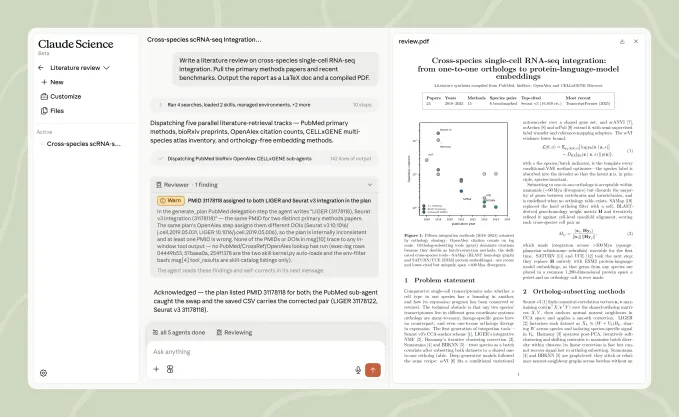
There's also a smart business logic here. If Claude Science becomes the environment where researchers live their computational lives, Anthropic embeds itself into the daily practice of science - not just as a chatbot you consult occasionally, but as the actual substrate of how research gets done. That's a very different kind of moat.
The boring revolution nobody's talking about
AI headlines love to scream about parameters, benchmarks, and AGI timelines. But sometimes the most impactful tech is the stuff that just... stops annoying you. Claude Science isn't promising to replace scientists. It's promising to stop making their lives unnecessarily harder.
Which, honestly? In 2025, might be the most radical thing an AI company could do.