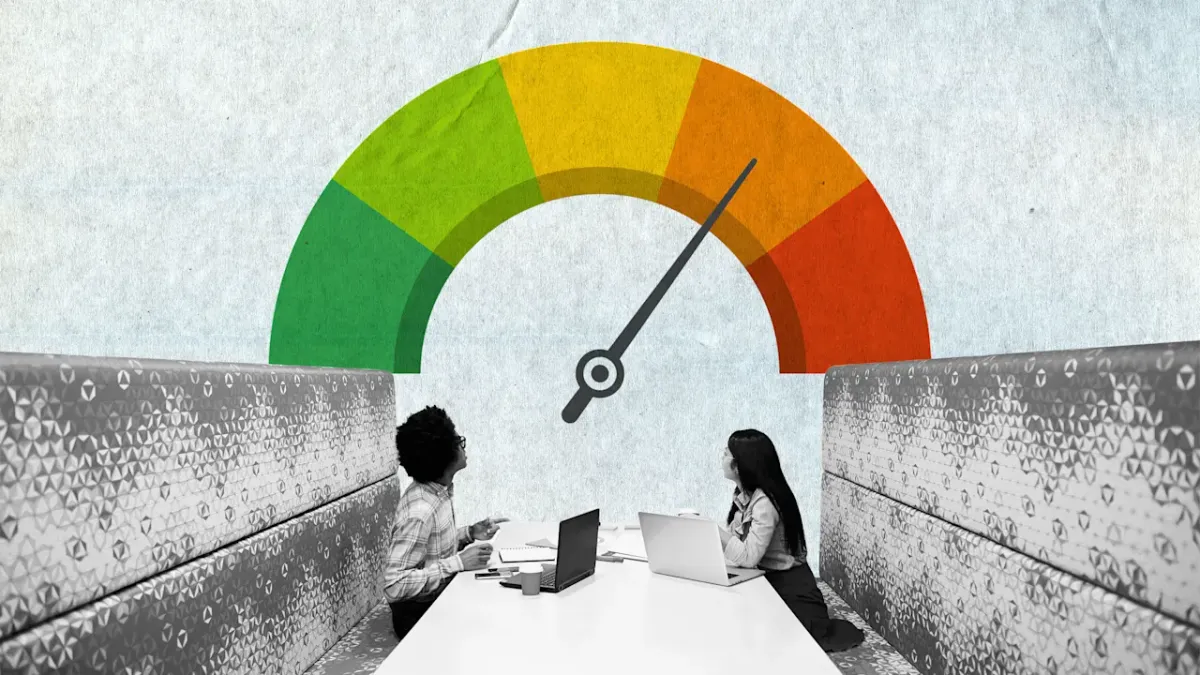
Here's an uncomfortable truth for anyone managing a team right now: the numbers you're probably tracking to measure success were designed for a world that's quietly disappearing.
As Fast Company recently reported, we're in the middle of a fundamental rethinking of what work is actually for. AI is taking on the routine cognitive tasks that once filled most of our working hours, which means the value humans bring is increasingly about imagination, connection, and creating meaning. The catch? Most organizations are still measuring performance using metrics built for a completely different era.
Metrics built to extract, not to create
Think about the KPIs that dominate most performance reviews: inventory turnover, cost per lead, utilization rates. These aren't bad numbers, but they were built to optimize a particular kind of work - one focused on efficiency, repeatability, and extraction. They tell you how well a machine-like system is running. They're not great at telling you how well your people are thinking, connecting, or innovating.
The problem is that as AI absorbs more of the mechanical work, the leftover human work becomes harder to quantify. How do you put a number on a breakthrough idea? How do you measure the quality of a relationship, or the moment a team collectively figures something out? These are real sources of organizational value, but they don't slot neatly into a spreadsheet.
The gap between what we measure and what now matters
This isn't just a management philosophy conversation - it has real consequences. Companies that cling to old metrics risk optimizing for the wrong things entirely. They might reward efficiency over creativity, or speed over depth, at exactly the moment when the opposite qualities are becoming more valuable.
It also affects how people experience their jobs. When the metrics don't reflect what you actually contribute, work starts to feel pointless. That's a retention problem, a culture problem, and ultimately a competitive problem.
So what comes next?
The honest answer is that nobody has a perfect replacement framework yet. But the conversation is clearly shifting toward measuring outcomes that reflect human strengths - things like the quality of ideas generated, the strength of collaborative relationships, and the ability to navigate ambiguity and uncertainty. Soft skills, in other words, are becoming hard metrics.
If you're leading a team or running a business, now is a genuinely good time to audit what you're actually measuring and ask whether those numbers still reflect what success looks like. The organizations that figure this out early are likely to have a real advantage - not just in performance, but in attracting people who want to do meaningful work.
And honestly, that sounds like a better way to work for everyone.