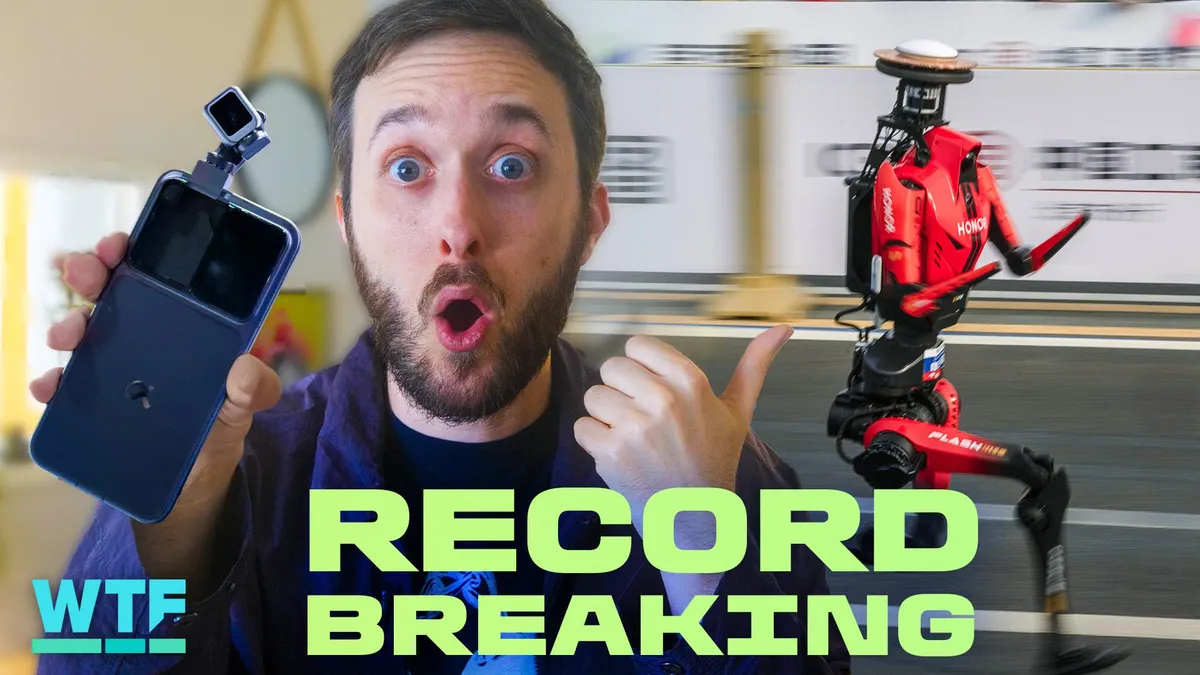
You probably know Honor as a smartphone brand. But the company has a new identity in mind - and it involves two legs, a humanoid frame, and a half-marathon record.
Honor's robot, called Flash, recently completed a half-marathon in record-breaking time for a humanoid robot. It's the kind of milestone that tends to make the tech world sit up and pay attention, and for good reason. Running 13.1 miles is not a trivial engineering challenge for a machine built to move like a human being. Balance, endurance, heat management, energy efficiency - these are genuinely hard problems, and Flash appears to have handled them well enough to set a new benchmark.
So why is a phone company building robots?
On the surface, it seems like an odd leap. But it actually makes a certain kind of sense when you consider where consumer technology is heading. Smartphones are a brutally competitive, increasingly saturated market. The next frontier for tech companies with serious hardware chops isn't a thinner screen or a better camera - it's physical AI. Robots that can move through the real world, assist people, and operate autonomously.
Honor isn't alone in thinking this way. We've seen companies from Tesla to Boston Dynamics to a wave of well-funded startups all betting big on humanoid robotics. The race is on, and the companies that develop the underlying hardware and software now could have an enormous head start as the market matures.
For Honor specifically, the move signals an ambition to be seen as more than a phone maker. Building Flash - and making it do something as visible and measurable as breaking a running record - is a smart way to announce that ambition to the world.
What this means for the rest of us
Records are interesting, but what really matters is what comes next. A humanoid robot that can run a half-marathon is impressive as a proof of concept. The question is whether that engineering capability translates into robots that can do useful things - help around the home, work in warehouses, assist in healthcare settings.
We're still a few years away from humanoid robots becoming a mainstream reality, but milestones like this one matter. They signal that the hardware is becoming more capable, more reliable, and more ready for the real world.
Honor may have started with smartphones. But if Flash is any indication, the company has much bigger ambitions - and the engineering to back them up.
Source: Mashable