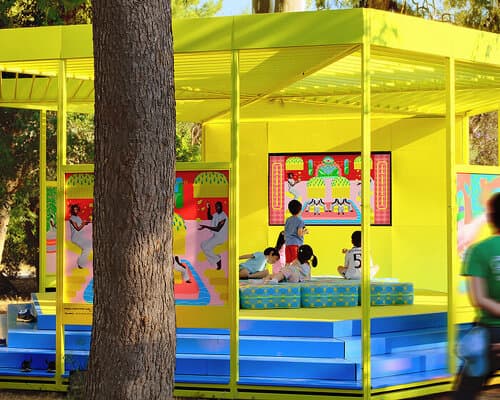
What if the way we imagine the future is itself broken - too individualistic, too linear, too disconnected from the wisdom of those who came before us? That's the quiet provocation at the heart of Toguna World, a multi-sensory installation by artist Pierre-Christophe Gam that's reframing how we think about time, memory, and collective possibility.
A temple with deep roots
Reported by Designboom, the work draws its name and spirit from the toguna - a traditional meeting structure found in Dogon communities in West Africa, historically used as a space for elders to gather, deliberate, and make decisions for the community. Gam's digital interpretation takes that spirit and scales it into an immersive experience built for our fragmented, screen-saturated moment.
The piece isn't just aesthetically inspired by African philosophy - it's structurally shaped by it. Concepts of cyclical time and ancestral memory aren't decorative touches here; they're the actual architecture of the work. Where Western frameworks tend to position the future as something purely ahead of us, the philosophies informing Toguna World treat past, present, and future as deeply intertwined. The ancestors aren't gone - they're part of the ongoing conversation.
Why this matters beyond the gallery
There's something genuinely refreshing about an artwork that takes collective imagination seriously as a practice. So much of our cultural infrastructure around the future - think tanks, forecasting reports, tech keynotes - centers individual visionaries or institutional power. Toguna World asks: what would it look like to build a framework for dreaming together?
The multi-sensory format is key to this. By engaging the body and senses rather than just the intellect, the work creates conditions where something closer to genuine shared experience becomes possible. It's less lecture, more ritual.
For an audience already drawn to questions of wellness, meaning, and how we live - not just how we consume - this kind of work lands differently than a typical gallery piece. It's pointing toward a real gap: the absence of communal, culturally grounded spaces for collective imagination in contemporary life.
Gam's nomadic vision
Described as a nomadic temple, Toguna World is designed to travel and adapt - which feels entirely appropriate for a work about futures plural rather than a single fixed destiny. The portability suggests Gam sees this less as a finished object and more as an ongoing invitation.
In a cultural moment where many of us are hungry for depth, rootedness, and genuine connection, a digital space that borrows its logic from ancient communal wisdom feels less like a contradiction and more like exactly what's needed.