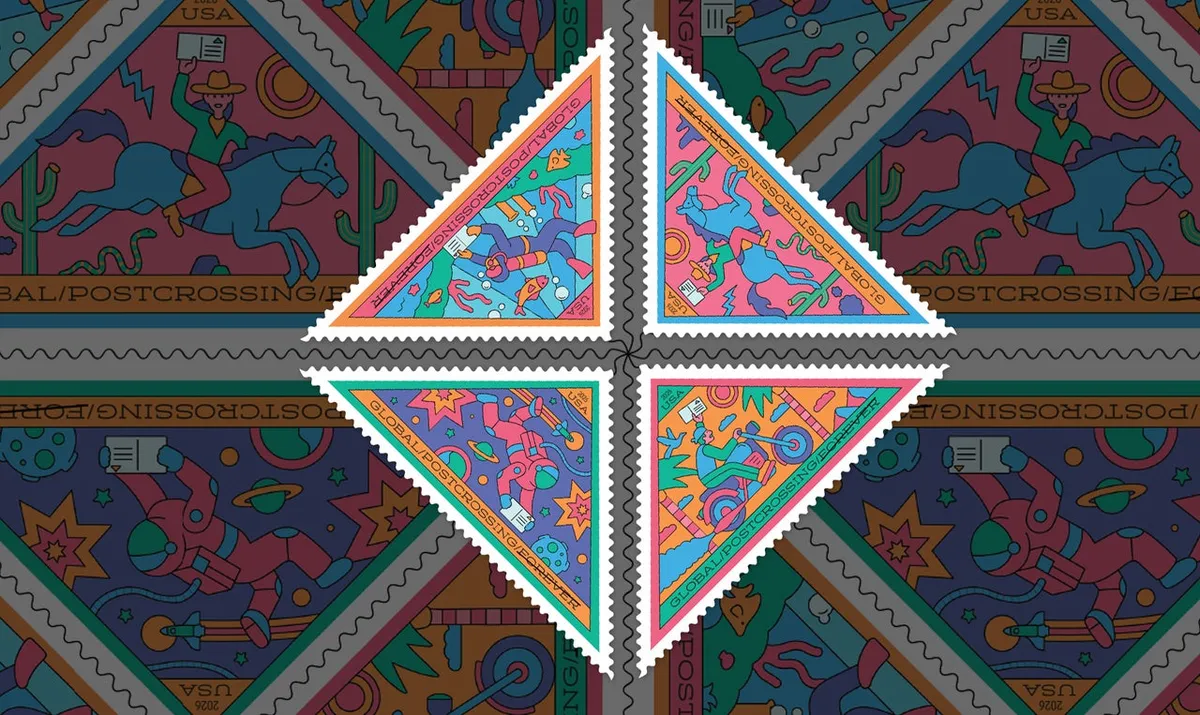
The US Postal Service has done something genuinely weird and kind of wonderful: it released a triangle-shaped stamp. Not rectangular. Not square. A triangle. And it's not just a quirky collector's item sitting in someone's dusty binder - it's fully functional postage, valid for international mail to over 180 countries.
But here's the part that really gets us: the stamp exists specifically to celebrate Postcrossing, an international pen pal project that's been quietly thriving since 2005. It was started by Paulo Magalhães, a Portuguese student who had a deceptively simple idea - connect strangers across the globe through postcards. You send one, you get one back. That's it. No algorithm. No engagement metrics. No doom-scrolling. Just paper and stamps and the mild thrill of a stranger's handwriting arriving in your mailbox.
From a personal computer to a global movement
What started as a website Magalhães ran off his own personal computer has since ballooned into a genuine worldwide phenomenon, connecting millions of people across dozens of countries. In an era where human connection is apparently something we need apps and subscriptions and AI companions for, a guy in Portugal just... made a website about postcards. And it worked.
The USPS commemorating this with not just any stamp, but a triangle stamp - geometrically rebellious, slightly chaotic, impossible to miss in a pile of boring rectangles - feels like exactly the right move. It's the philatelic equivalent of showing up to a meeting in a velvet blazer. Technically fine. Definitely a statement.
Why this actually matters
Look, we live in a world where sending a text message feels like too much effort and voice notes are somehow controversial. The idea that people are still voluntarily writing postcards to complete strangers, addressing them by hand, walking to a post box, and waiting for a response is either deeply touching or mildly unhinged. Possibly both.
But that's exactly why the Postcrossing stamp feels significant. It's a small, triangular reminder that slow, tangible, human connection still has a place - and that sometimes the most radical thing you can do is send someone a postcard of your city and hope they send you back a picture of theirs.
Pick up the stamp. Write something. Mail it to a stranger in Finland or Brazil or wherever. It'll probably be the most interesting thing you do this week.