It's 2026. Warfare involves AI-guided drones, satellite intelligence, and precision munitions. And Russia's answer to all of that? A can of spray paint and a very bold aesthetic choice.
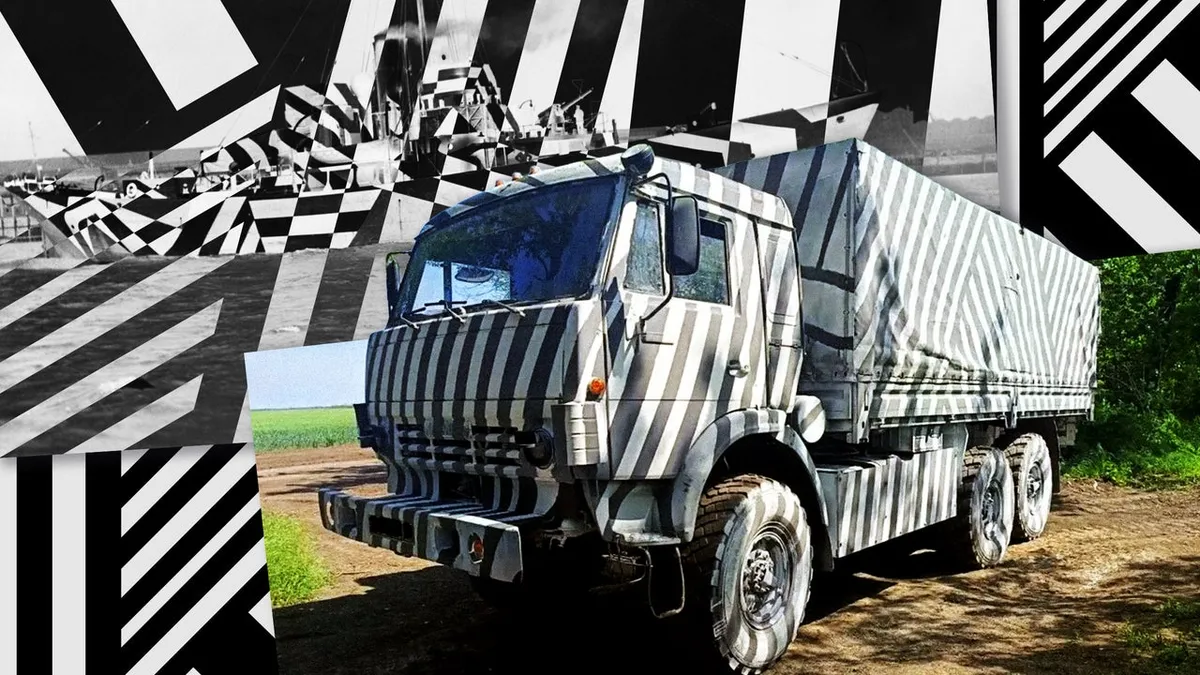
According to Fast Company, Russian forces have been painting their logistics trucks with stark black-and-white zigzags and irregular blotches - covering everything from the chassis all the way down to the tires. If you're picturing a military truck that looks like it got into a fight with a 1920s abstract art movement, you're basically there.
Wait, didn't they try this on battleships?
Yes. Yes they did. This technique is called 'dazzle camouflage,' and the British Royal Navy pioneered it during World War I. The idea was never to make ships invisible - you can't exactly hide a battleship - but to make them confusing. The wild geometric patterns were designed to mess with enemy range finders and submarine crews trying to calculate a ship's speed and direction.
It was less 'you can't see me' and more 'you have absolutely no idea what I'm doing.' Which, honestly, as a life philosophy, has some merit.
So why is Russia doing this now?
Ukrainian drone operators have been absolutely punishing Russian supply lines. These cheap, nimble drones can identify and strike vehicles with terrifying efficiency - and that is a massive problem when you're trying to move fuel, ammunition, and equipment to the front.
The dazzle paint job is apparently aimed at confusing the targeting systems and human operators behind those drones. The theory is that the high-contrast geometric patterns disrupt how a drone's camera - or the person watching the feed - perceives the vehicle's shape, size, and movement.
Does it work? That's genuinely unclear. But the fact that Russia is reaching back over a century for a solution tells you something pretty significant about how effective Ukrainian drone warfare has become.
History called, it wants its coping mechanism back
There is something almost poetic about ultra-modern drone warfare being met with an answer that a British naval officer sketched out before the Jazz Age. It's the military equivalent of fighting a cyber attack by unplugging your router.
But here's the thing - desperate improvisation in wartime has a long history of accidentally working. Sometimes the dumbest-looking solution is the one that buys you just enough time. And in a conflict where supply lines are life or death, 'just enough time' matters enormously.
So next time you see a truck that looks like it was designed by a Cubist painter having a breakdown, don't laugh. Or do. But know that someone, somewhere, thought this was a genuinely good idea - and the fact that we're all talking about it suggests they might not be entirely wrong.