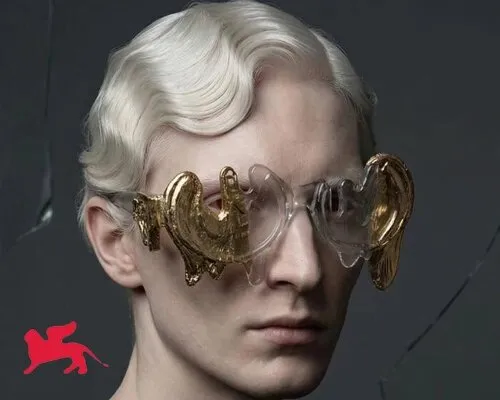
What if the very thing designed to help you see clearly was itself falling apart? That's the quietly unsettling question at the heart of a striking new work appearing at the Venice Biennale, where eyewear crafted from glass and gold seems to melt before your eyes.
Where sculpture meets optics
The piece, reported by Designboom, blurs the lines between sculpture, design, and the science of vision in a way that feels genuinely fresh. Eyewear is one of those objects we rarely think of as art - it's functional, everyday, almost invisible. So when you encounter frames that appear to be liquefying, the effect is both visually arresting and conceptually loaded.
The melting silhouette isn't just a stylistic flourish. It's a deliberate statement about distortion - specifically, distortion within the systems we use to perceive the world around us. Glasses are tools of clarity, so warping them into something unstable flips the whole premise on its head.
Why this kind of work resonates right now
There's something deeply timely about an artwork that interrogates vision and perception. We're living in an era of information overload, filtered realities, and heavily mediated experiences. The idea that the instruments of sight could themselves be unreliable - or even deceptive - hits differently when you think about it in that context.
The use of glass and gold as materials adds another layer. Both are precious, both carry cultural weight, and both have a certain fragility beneath their surface elegance. Gold suggests value and permanence, while glass is inherently breakable. Combining them in a form that appears to be in the process of collapse creates a tension that's hard to look away from.
The intersection of fashion and fine art
Eyewear has had a long, interesting relationship with identity and self-expression - think of how much a pair of frames can communicate about who you are. Bringing that object into the gallery space and distorting it forces you to reconsider both its function and its symbolism at the same time.
Venice Biennale has always been a place where boundaries between disciplines get productively messy, and this work fits right into that tradition. It's the kind of piece that stays with you after you've left the room - not because it's loud or overwhelming, but because it asks a deceptively simple question and refuses to give you a neat answer.
Sometimes the most interesting art is the kind that makes you look twice at something you thought you already understood.