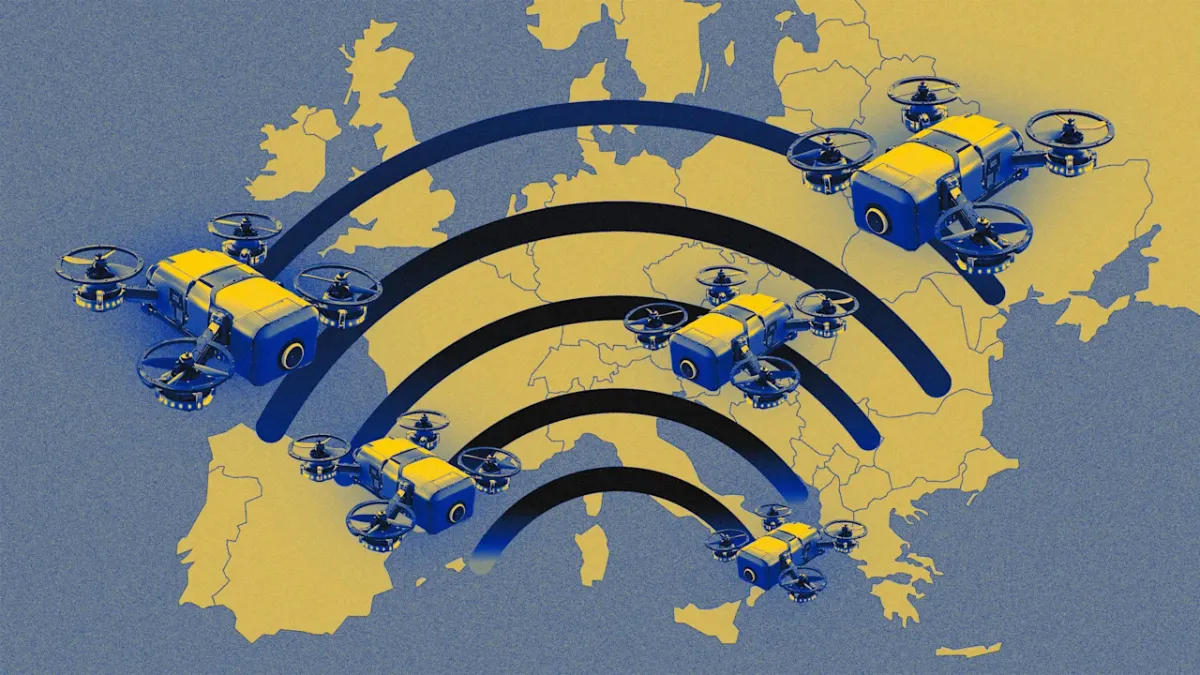
Drones are no longer just a hobbyist obsession or a military footnote. They're a genuine security headache - buzzing near airports, hovering over nuclear facilities, and showing up in conflict zones with alarming frequency. Now, Europe is getting serious about fighting back.
According to Fast Company, two public innovation agencies that have historically operated in their own lanes - Germany's SPRIND (the Federal Agency for Disruptive Innovation) and Sweden's Vinnova - have joined forces to fund teams building counter-drone systems across the continent. The goal is to protect airports, nuclear plants, and other civilian infrastructure from hostile unmanned aircraft.
Why this collaboration matters
The partnership signals something bigger than a single funding initiative. It reflects a growing recognition that the threats Europe faces - technological, geopolitical, and security-related - don't respect national borders, and neither should the solutions. Think of it as Europe's answer to DARPA, the legendary US defense research agency known for backing the kinds of wild, forward-thinking projects that eventually reshape how we live and fight.
One of the teams involved is led by Martin Saska, a robotics professor at Czech Technical University, which gives you a sense of the academic firepower being brought to bear. This isn't just bureaucrats writing policy papers - it's engineers and researchers building real systems designed to detect, track, and neutralize drone threats in real time.
The bigger picture
Counter-drone technology sits at an interesting intersection of civilian safety and defense. An airport disrupted by a rogue drone doesn't just cause flight delays - it creates cascading economic and logistical chaos. A drone near a nuclear facility is a potential catastrophe waiting to happen. As these aircraft become cheaper and more capable, the need for robust defenses has moved from theoretical to urgent.
What's particularly compelling about this European push is the model itself. Rather than leaving innovation to defense contractors alone, these agencies are pulling in universities, startups, and research institutions from across the continent. That kind of open, distributed approach tends to produce faster breakthroughs - and potentially more creative ones too.
For the average person, this might feel distant from everyday life. But the safety of the infrastructure we all rely on - the airports we fly through, the energy grids that keep our lights on - depends on exactly this kind of forward planning. Europe building its own disruptive innovation ecosystem, with real funding and real urgency, is worth paying attention to.