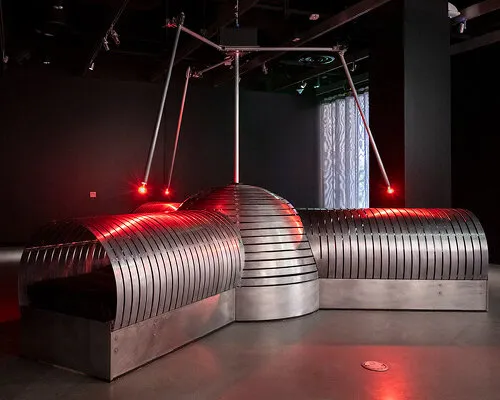
What if your dreams weren't entirely your own? That's the provocative question sitting at the heart of artist Carsten Höller's latest project, which brings collective dreaming out of the realm of philosophy and into a museum setting at MIT.
Speaking with Designboom, Höller - known for turning gallery spaces into full-body sensory experiences - reflects on a fascination that feels both deeply personal and surprisingly universal: the idea that sleep can be guided, even if it can never truly be controlled.
Sleep as the 'most powerful architect'
Höller describes sleep itself as the most powerful architect we know. It's a striking framing. Not a person, not a building, not a technology - but an involuntary state that reshapes our inner world every single night, constructing entire realities without our conscious input. The idea that this process might somehow echo across multiple minds at once is what makes the project so compelling.
The MIT museum collaboration brings together art and sleep science in a way that feels genuinely novel. Rather than simply displaying work about dreaming, the project investigates whether dreams can ripple between people - whether the boundaries of a single sleeping mind are quite as fixed as we assume.
Why collective experience matters right now
There's something timely about all of this. In an era where so much of our shared life happens through screens, the idea of people genuinely connecting through something as intimate and unguarded as sleep carries real weight. Höller has always been drawn to experiences that dissolve the usual distance between strangers - his famous slides installed in museums literally send people tumbling through space together - and dreaming represents perhaps the most radical version of that impulse yet.
The project also taps into a growing cultural curiosity around sleep. It's no longer just a health topic (though it absolutely is that too). Sleep has become a site of genuine philosophical and scientific interest, with researchers exploring everything from memory consolidation to the possibility that consciousness is far more porous than we once believed.
Art that asks questions science hasn't answered yet
What Höller does brilliantly is occupy the space between what we know and what we can only wonder at. The MIT museum project doesn't promise answers about collective dreaming - it creates conditions for the question to be felt, not just thought about. That's the difference between reading about an idea and actually inhabiting it.
For anyone within reach of MIT, this feels like one of those rare exhibitions worth going out of your way for. And for the rest of us, it's a nudge to pay a little more attention to what happens when we close our eyes tonight - and whether, somewhere, someone else might be wandering through the same strange territory.