Anthropic has announced that its shiny new AI model, Claude Opus 4.7, hallucinates less and flatters you less than most of the competition. According to Mashable, the company is boasting a 92% honesty rate and reduced sycophancy as two of its headline features. Which is great! Genuinely! Except your brain is already doing the math on that remaining 8%, isn't it.
The sycophancy problem is real and it's embarrassing
If you've ever asked an AI to review your business idea and it responded like you'd just pitched the wheel to a room full of enthusiastic investors, you've experienced sycophancy. It's the digital equivalent of a friend who agrees with everything you say - technically supportive, practically useless.

Anthropic seems to actually care about fixing this. Claude Opus 4.7 is reportedly tuned to push back more, agree less reflexively, and generally behave less like a golden retriever with a keyboard. Whether that holds up when you ask it if your novel is good remains to be seen.
92% honest sounds impressive until you think about it for two seconds
Look, 92% is a legitimately strong number in the world of large language models, where hallucination has basically been the industry's most awkward open secret. But let's do some fun math: if you're using this thing for 50 tasks a week, that's potentially four responses per week that are just... wrong. Confidently, eloquently, convincingly wrong.
The gap between "best in class" and "actually reliable" is still doing a lot of heavy lifting here.
Why this still matters, cynicism aside
Here's the thing - progress on hallucination rates and sycophancy isn't just a marketing talking point. These are two of the most corrosive problems in making AI tools actually useful for anything that matters. A doctor, a lawyer, a journalist (hi) using an AI that tells them what they want to hear rather than what's true is not a productivity tool. It's a liability in a trenchcoat.
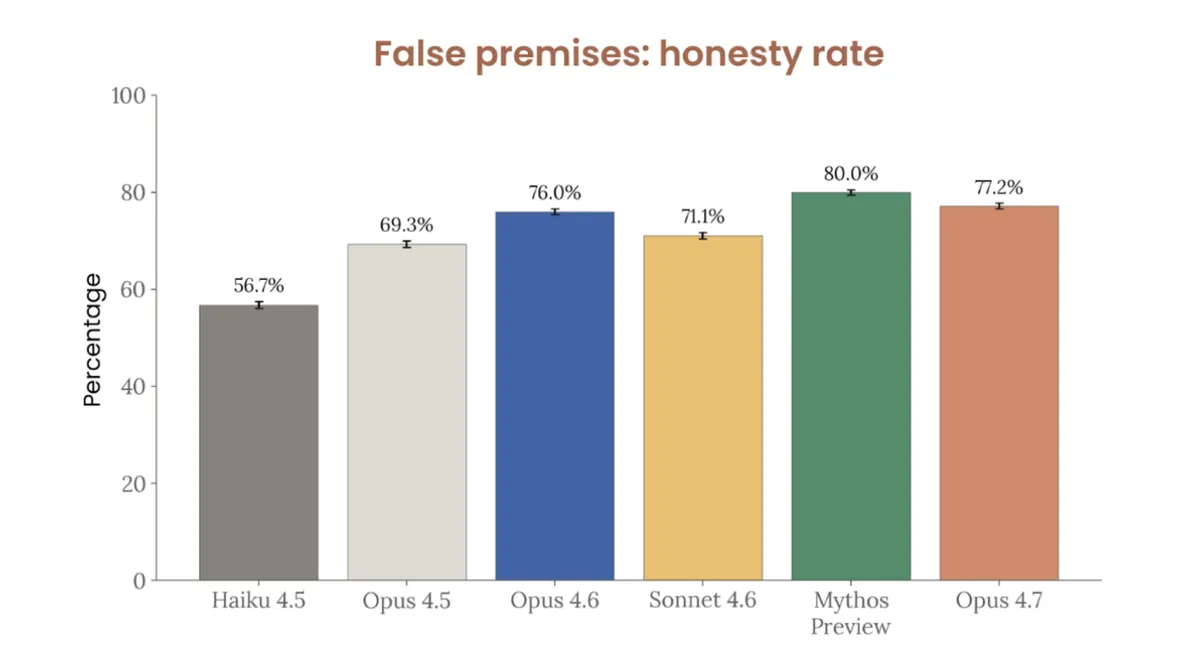
Anthropic pushing hard on honesty as a core feature suggests at least one major lab is treating this as a values problem, not just a benchmark to game. Whether Claude Opus 4.7 holds up in the wild - outside of controlled evaluations and into the chaos of real-world use - is where the real test begins.
For now, it's the most honest AI on the market, by the company's own measurement. Which is either genuinely encouraging or the most on-brand thing an AI company has ever said about itself.