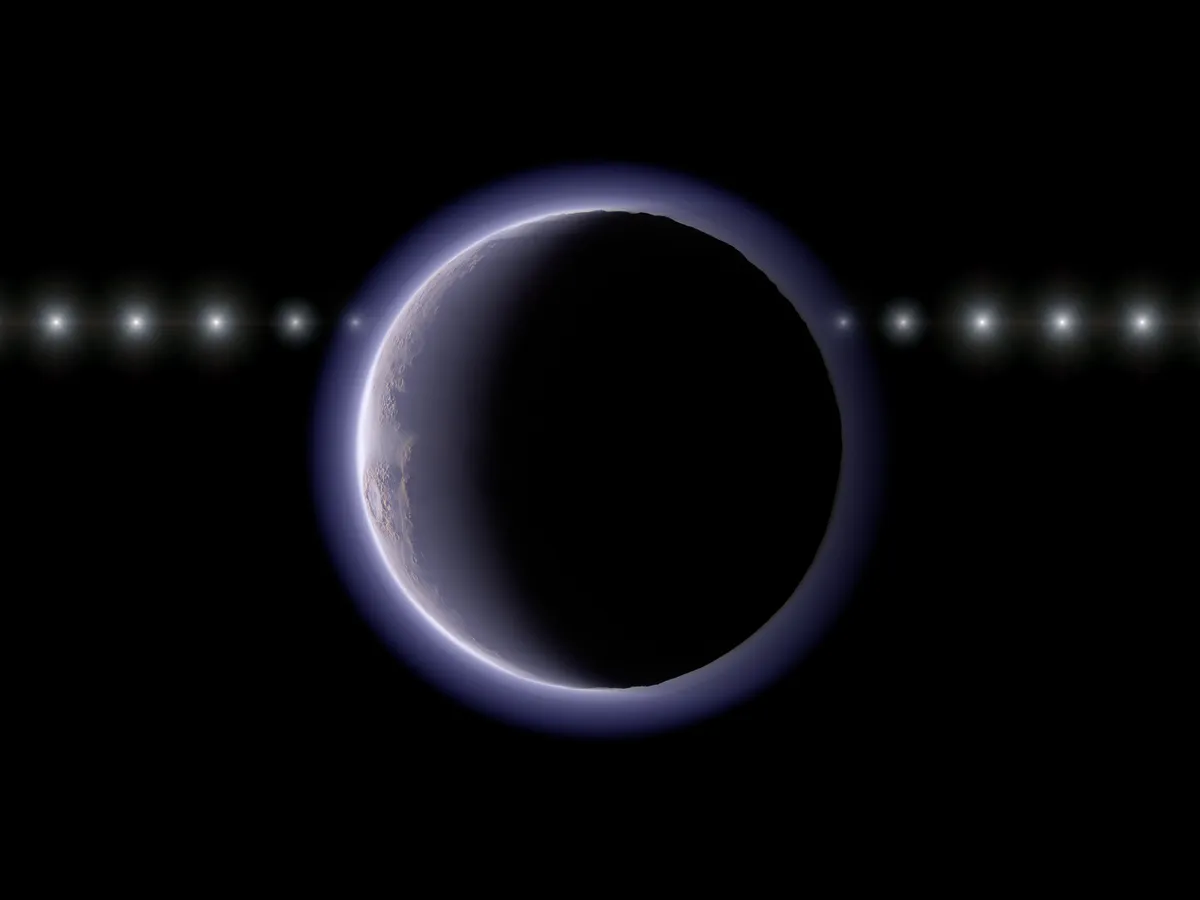
You don't have to travel to Mars or Europa to find something surprising. Way out at the frozen edges of our solar system, scientists have discovered that a small, obscure object called 2002 XV93 appears to be carrying its own thin atmosphere. Yes, really.
As reported by Mashable, 2002 XV93 is what's known as a Trans-Neptunian Object - a chunk of icy rock that orbits the Sun beyond Neptune in a region scientists call the Kuiper Belt. These objects are generally considered cold, dark, and unremarkable. That's what made this discovery so unexpected.

What they actually found
Researchers detected signs of a tenuous atmosphere clinging to the surface of this tiny world. We're not talking about anything you could breathe - or even really see. It's an extremely thin envelope of gas, and scientists believe it could be temporary rather than permanent.
That temporary quality is actually part of what makes it fascinating. The atmosphere likely forms as the object moves closer to the Sun during its orbit, causing ices on its surface to sublimate - essentially skip the liquid phase and go straight from solid to gas. When it drifts further away again, that fragile atmosphere probably collapses back down.
Why this matters beyond the headlines
It's easy to file this one under "cool space stuff" and move on, but the implications are worth sitting with for a moment. Finding even a fleeting atmosphere around such a small, remote object raises real questions about how common this phenomenon might be across the solar system. How many of these icy bodies out there are doing the same thing, without us knowing?
It also adds another layer of complexity to our understanding of Pluto, which famously has its own thin nitrogen atmosphere that expands and contracts with its orbit. 2002 XV93 is significantly smaller than Pluto, which makes the detection all the more striking.
For scientists studying the outer solar system, each discovery like this chips away at the assumption that the distant reaches of our cosmic neighborhood are simple or static. They're not. Even the smallest, most distant objects are apparently doing interesting things - we just need to look closely enough to catch them at it.
It's a good reminder that the universe has a habit of being more dynamic than we expect, even in the places we'd least think to check.