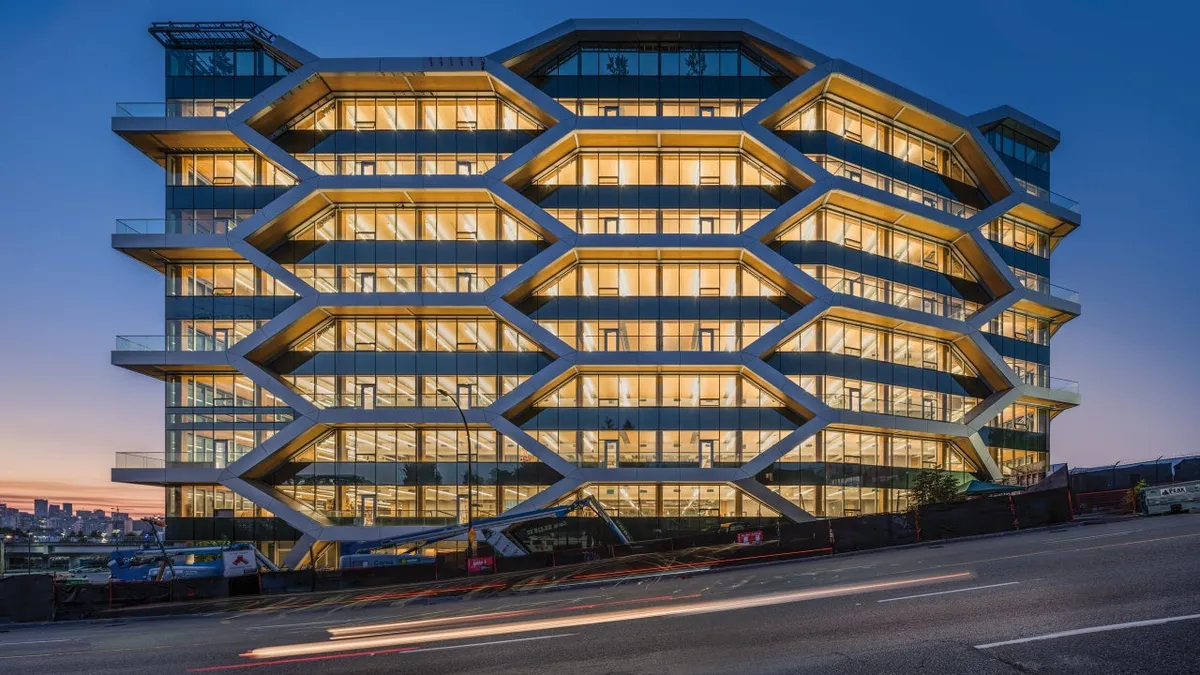
If you're driving into downtown Vancouver through the False Creek Flats neighborhood and you spot what appears to be a giant honeycomb cosplaying as a skyscraper, don't panic. That's just the Hive, and it's probably one of the most interesting buildings to go up in North America in recent memory.
Designed by Toronto-based architecture studio Dialog, the Hive is a 10-story office building made almost entirely from wood - specifically mass timber, which is the kind of engineered lumber that's been quietly revolutionizing construction for the past decade. But what makes this building genuinely remarkable isn't just the material or the eye-catching hexagonal exterior. It's what's happening underneath all that wood veneer.
The building that learned to go with the flow
Here's the part that should make every structural engineer in the room start sweating with excitement: the Hive is designed to survive earthquakes not by rigidly resisting them, but by allowing itself to wiggle, shake, and settle. Think of it less like a stubborn immovable object and more like a really tall, very composed person riding a crowded subway. You move with it, you stay standing.
According to Fast Company, this makes the Hive the tallest seismic-force-resisting building made from mass timber - which is a sentence that would have sounded like pure science fiction just twenty years ago. Wood, the material humans have been building things with since before recorded history, is now at the cutting edge of earthquake engineering.
Why wood, and why now?
Mass timber has been having a serious moment. It's lighter than concrete and steel, it stores carbon instead of releasing it during production, and - clearly - it can be engineered to handle serious structural demands. The Hive leans hard into all of this, pairing the honeycomb aesthetic with genuine technical ambition.
The result is a building that manages to be both deeply nerdy and genuinely beautiful, which is a combination that doesn't come along nearly enough in modern architecture. It's sustainable, it's structurally innovative, and it looks like something a very gifted architect designed in Minecraft before realizing they could just build it in real life.
For Vancouver, a city that sits in a seismically active region and has increasingly ambitious green building goals, the Hive might just be a preview of what urban construction looks like going forward. A city full of buildings that flex instead of crack sounds pretty good, honestly.
The age of the earthquake-proof wooden beehive is here. And somehow, it rules.