Remember corridors? Those beige, soul-crushing tunnels you sprinted through between classes, occasionally getting told off for running? Yeah, someone in India looked at that concept and said: absolutely not.
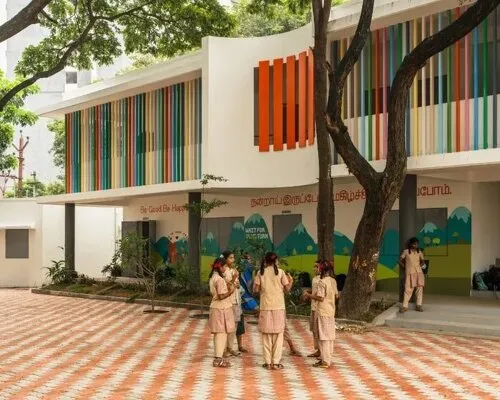
At Kavundampalayam Government School, the design studio Mawi Design has done something that sounds simple but is actually kind of radical - they treated the circulation spaces (architect-speak for hallways, ramps, and in-between zones) as genuine opportunities for learning, play, and community gathering, rather than just the awkward bits connecting the "real" rooms.
Color as infrastructure
The transformation leans heavily on bold, intentional color and movement-friendly spatial design. Instead of corridors being the dead zones where nothing educational happens, they become extensions of the classroom itself. Think interactive surfaces, visual stimulation, and spaces that invite kids to actually stop, engage, and think - rather than just shuffle from point A to point B with their heads down.
This matters more than it might sound. In a government school context, where budgets are tight and square footage is precious, squeezing learning potential out of every single meter is not just good design - it's genuinely strategic. You're not adding space, you're activating the space you already have.
Why the hallway has always been underrated
Here's the slightly uncomfortable truth that this project puts front and center: a huge chunk of school infrastructure is essentially wasted. Corridors typically account for a significant portion of a school building's total area, and most of that real estate is doing absolutely nothing except connecting doors. That's a lot of square meters of missed potential, especially in public schools with limited resources.
Mawi Design's approach at Kavundampalayam reframes these transitional spaces as what researchers sometimes call "third spaces" - not home, not a formal classroom, but something in between that can be surprisingly powerful for informal learning and social development.
The vibe matters, actually
There's also just something to be said for the psychological effect of moving through a space that's visually alive versus one that makes you feel like you're inside a filing cabinet. Color and spatial generosity signal to kids that this place was designed with them in mind - and that signal matters more than we usually give it credit for.
As reported by Designboom, the project is part of a broader rethinking of what a school campus can be when you stop treating non-classroom space as a necessary evil and start treating it as a design opportunity.
It's a relatively modest intervention in terms of scale. But the idea it represents - that learning doesn't only happen inside four walls with a whiteboard - is the kind of thinking that more school design desperately needs.