
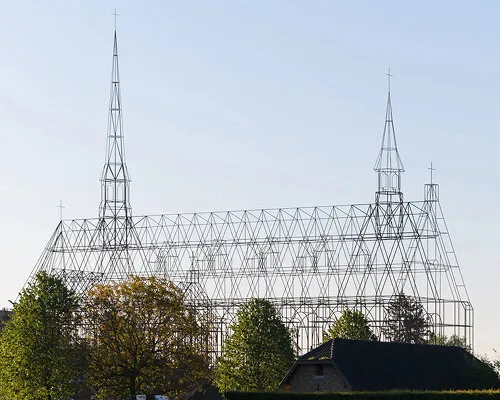
What do you do when a centuries-old abbey gets demolished and all that's left is an empty field and a vague sense of architectural grief? If you're Belgian design duo gijs van vaerenbergh, you rebuild the whole thing in translucent steel and make everyone's jaw drop.
That's essentially what happened at Herkenrode Abbey, a historic site in Belgium where the original cloisters were lost to time. According to Designboom, the duo created a full-scale ghost-like steel framework that reconstructs the vanished structure - not as a solid replica, but as a see-through skeletal outline that lets the landscape bleed right through it.
Architecture as memory, but make it cool
The result is less "boring historical recreation" and more "what if a medieval abbey and a modern art installation had a very elegant baby." The steel framework traces the exact footprint and volume of the lost cloisters, meaning you're walking through actual history - you're just also walking through air at the same time.
This is the kind of project that makes you realize absence can be a design material. The transparency of the structure means it shifts depending on where you're standing, the light conditions, the season. It's one building that looks completely different every single time you visit. Museums wish they had this kind of replay value.
Why this matters beyond the aesthetic flex
There's something genuinely profound going on here beneath the visual wow factor. Heritage preservation has long wrestled with a fundamental question: do you rebuild what's lost, risking a fake-looking copy, or do you just put up an informational plaque that nobody reads? Gijs van vaerenbergh found a third option - honor the shape of what was there without pretending the original still exists.
The translucent steel is honest about what it is. It's not trying to fool you into thinking you're looking at a 12th-century stone cloister. It's saying "this is where something beautiful used to be, and we think that's worth acknowledging at full scale."
The nerdy detail that makes it even better
The fact that it's built to actual scale is the detail that really gets you. This isn't a miniature model or a symbolic gesture - it's a full architectural reconstruction in steel, meaning you can walk the same paths that monks walked centuries ago. The space works spatially the way it always did. Your body understands the proportions even if your eyes can see straight through the walls.
It's the architectural equivalent of a palimpsest - a manuscript where old text shows through new writing. History layered over itself, visible all at once.
Honestly, more ruins should get this treatment. Someone call Stonehenge.