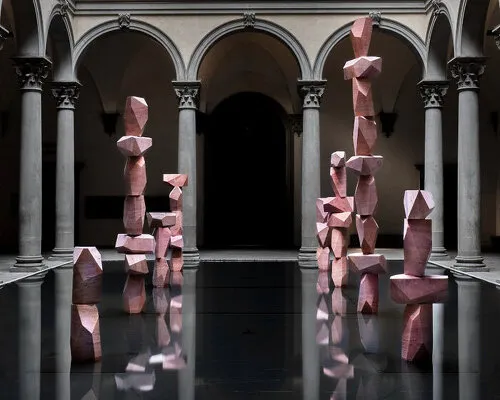
Imagine walking into one of Florence's most jaw-dropping Renaissance palaces, expecting marble floors and hushed reverence, and instead finding yourself face-to-face with a vision of the ocean slowly reclaiming everything you love. That's exactly what SUPERFLEX, the Danish art collective known for making people deeply uncomfortable in very stylish ways, has pulled off at Palazzo Strozzi.
What's actually going on here
The installation - on view until August 2nd, 2026 - is a site-specific piece that essentially reimagines the palace's famous courtyard as a future habitat for marine life. Think less "decorative fountain" and more "what happens when sea levels stop being a distant problem and start being everyone's interior design challenge."
The work sits right at the intersection of ecological anxiety and architectural imagination, asking a question most of us prefer not to answer over dinner: when the water comes, who gets to live here next?
Why this hits different in Venice
Showing climate art in a Florentine palace is provocative enough. But doing it in the broader context of Venice - a city that is, let's be honest, already auditioning for the role of "first major European city to go full Atlantis" - gives the whole thing an urgency that no press release could manufacture.
SUPERFLEX isn't just making a pretty installation about sad fish. They're rethinking coexistence between human and non-human life in a place where that conversation has a very real, very wet deadline.
Art that rage-baits your brain (in a good way)
There's something deeply unsettling and weirdly beautiful about seeing future refuges for marine creatures designed into a space built to celebrate human power and permanence. Palazzo Strozzi was built to impress. SUPERFLEX has turned it into a humility check.
The collective has a track record of this kind of conceptual judo - taking institutions seriously enough to use them against themselves. And it works here. You can't look at the installation without doing a little mental math about timelines, coastlines, and what we're actually leaving behind.
Should you go?
If you're anywhere near Florence before August 2026, yes, absolutely. Not because it'll be relaxing - it won't be - but because it's the rare piece of art that makes a genuinely complex problem feel immediate without being preachy about it.
Also, fish in a Renaissance palace. Come on. That's worth the trip alone.