Let's be honest: nobody ever said "I went to a historic architectural landmark and the highlight was the public restroom." Until now, maybe.
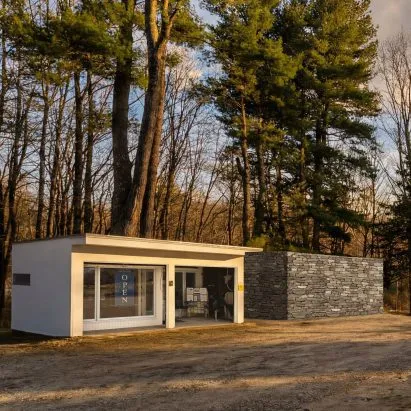
Isabel Strauss, architectural designer and apparently a person with the audacity to make a bathroom interesting, has won a design competition to build a public restroom on the grounds of the Gropius House in Lincoln, Massachusetts - the iconic self-designed home of German-American Bauhaus legend Walter Gropius himself.
Hundreds of submissions. One winner. For a bathroom.
The competition was launched by Historic New England, the preservation organisation that stewards the Gropius House, and it drew hundreds of entries. Hundreds! For a loo! Which honestly says a lot about how much architects love a good brief - or a good challenge.
Strauss's winning design is called One Bathroom After Another, which is either a deeply philosophical statement about the human condition or just a very good pun. Possibly both. According to reporting by Dezeen, the design mirrors the footprint of the existing Gropius House itself - a move that's either brilliantly reverential or the architectural equivalent of showing up to a party wearing the same outfit as the host. Either way, it works.
Why does a bathroom at a historic house actually matter?
Here's the thing: public restrooms at heritage sites are one of those unglamorous problems that institutions quietly struggle with for decades. Too modern and they clash with the historic fabric. Too sympathetic and they look like a bad pastiche. Get it wrong and you've got visitors either holding it in or cringing at a plastic porta-potty next to a Bauhaus masterpiece.
A thoughtfully designed bathroom says: we take the whole visitor experience seriously, not just the bit where you stand outside nodding at the architecture before Googling where the nearest cafe is.
Strauss's approach - echoing the Gropius House's own geometry - is a genuinely clever solution. It acknowledges the existing building without trying to compete with it, which is exactly the kind of quiet confidence good contextual architecture is supposed to have.
The bigger picture
There's something quietly radical about putting serious design attention into a public bathroom. It's the kind of project that doesn't win you a magazine cover, but it might just change how hundreds of visitors experience a site they came to love. That's not nothing. That's actually quite a lot.
Walter Gropius, who spent his career arguing that good design should be accessible and functional for everyone, would probably approve. Or at least, he would not be mortified. Which, at a site this significant, is the bar.