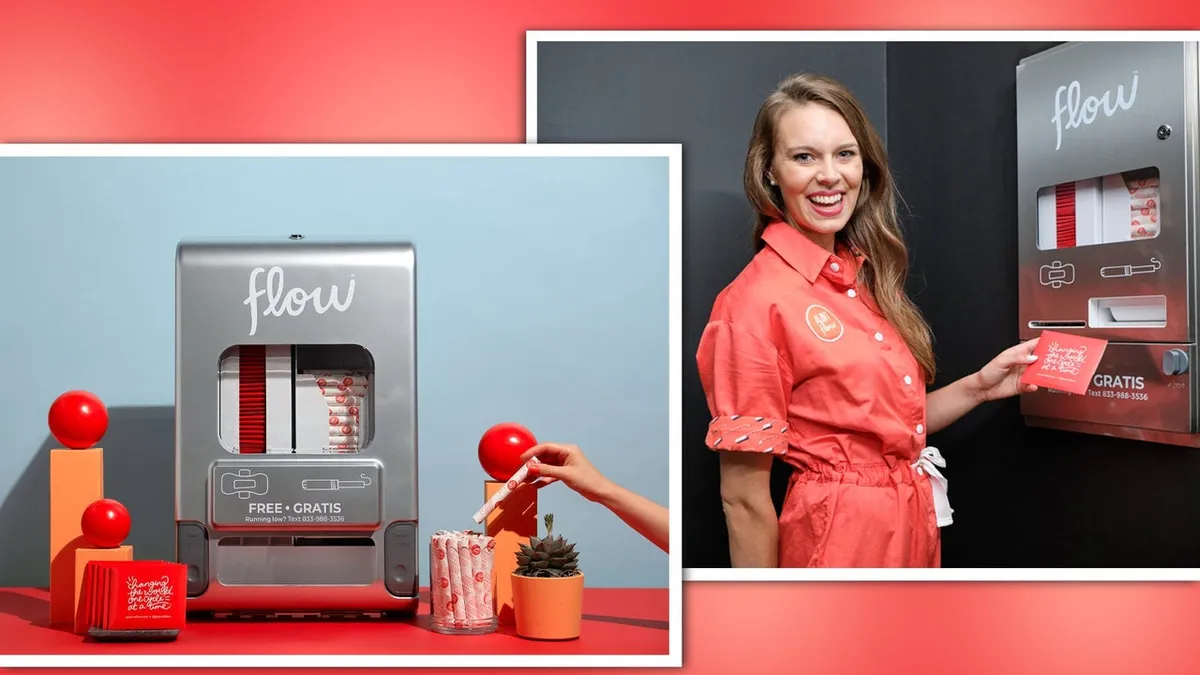
Picture this: you're at a professional event, looking sharp, feeling confident - and then your period shows up unannounced like that one coworker who never reads the room. You dash to the restroom. And there it is. A crusty, coin-operated metal box bolted to the wall, demanding a quarter like it's 1987.
Who carries quarters anymore? Nobody. That's who.
For most people, this is a minor inconvenience filed away under "ugh, whatever." For Claire Coder, it was something else entirely - a lightning bolt of a business idea dressed up as a bad bathroom experience.
The question that started it all
Coder, who dropped out of college at just 18, couldn't shake one simple but genuinely radical thought: toilet paper is free in public restrooms. So why aren't period products? According to Fast Company, that question became the foundation of what is now a hardware-as-a-service startup taking aim at a multibillion-dollar industry.
It's the kind of idea that sounds obvious the second someone says it out loud - and that's usually the sign of a great one. Of course period products should be freely available in restrooms. Of course the solution shouldn't involve hunting for loose change like you're about to do laundry at a 1990s laundromat.
Disruption, but make it practical
What makes Coder's approach interesting isn't just the "periods should be free" angle - it's the hardware-as-a-service model. Rather than just selling a product, she built a system. Think of it like the Nespresso model, but for something that actually matters to half the population on a monthly basis and doesn't cost five dollars a pod.
Dropping out of college is the kind of move that sounds reckless until it very much isn't. And while the startup world is absolutely littered with dropout mythology (yes, we all know about Zuckerberg), Coder's story stands out because the problem she's solving is one that gets eyerolled into invisibility constantly - despite affecting billions of people worldwide.
Why this actually matters
Period poverty is a real, documented issue. The fact that workplaces, schools, and event venues still rely on a busted metal box as their entire strategy for menstrual health says a lot about whose comfort has historically been treated as an afterthought.
Coder looked at that rusty quarter machine and decided it was a market gap, not just an annoyance. That reframe - from "this is inconvenient" to "this is a solvable problem and also a business" - is exactly the kind of thinking that actually moves things forward.
Sometimes the most disruptive ideas are just the ones that ask the most obvious question nobody bothered to ask before.