
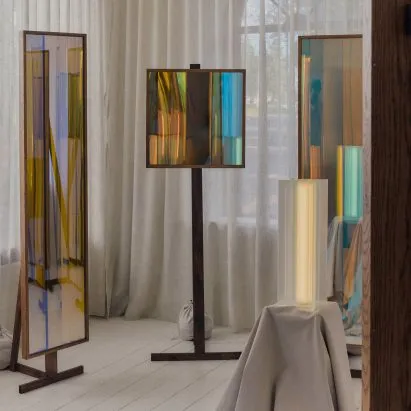
If you still think of Australian design as "that kangaroo leather wallet you bought at the airport," Melbourne Design Week has officially revoked your opinion. According to Dezeen, this year's edition packed over 400 exhibitions, talks, and workshops across the city - making it the largest design week on the continent. And some of what showed up is genuinely worth losing sleep over.
Wait, algae marble is a thing?
Yes. Actual algae, turned into something that looks like marble. That sentence alone should have you reconsidering every surface in your home. It's the kind of material innovation that sounds like a fever dream but lands as genuinely beautiful design - exactly the sort of thing that makes design weeks worth attending instead of just scrolling past on Instagram.
And then there are the champagne buckets. Playful ones. Champagne buckets with personality, which is a sentence nobody expected to need in 2025, yet here we are, completely on board with it.
Over 100 chairs. ONE HUNDRED CHAIRS.
One of the standout exhibitions featured more than 100 chairs - all designed and made in Australia. Now, chairs are one of those objects that designers love to fight about (and honestly, fair enough - a bad chair is a slow personal catastrophe), so putting over a century's worth of them in one room is either an act of curatorial genius or the world's most comfortable argument. Probably both.
The sheer number signals something important: Australian maker culture is not a niche hobby. It's a movement with enough momentum to fill a room with seating and still have things to say.
Why this actually matters
Design weeks can feel like expensive mood boards for people who already know what they like. But Melbourne Design Week, as quoted via Dezeen, frames itself as more than just a showcase - it's about what Australian design IS, not just what it looks like on a shelf.
That distinction is doing a lot of heavy lifting right now, when global design conversation still defaults to Scandinavian minimalism or Italian maximalism. Watching a city carve out serious space for its own maker community - with algae and champagne buckets and an absurd number of chairs as its weapons of choice - is kind of wonderful.
Australia, it turns out, has been busy. The rest of the world should probably pay attention.