If there's one fashion house that understands how to make a statement without saying the obvious, it's Maison Margiela. And the brand's latest project in China is a perfect example of that philosophy at work.
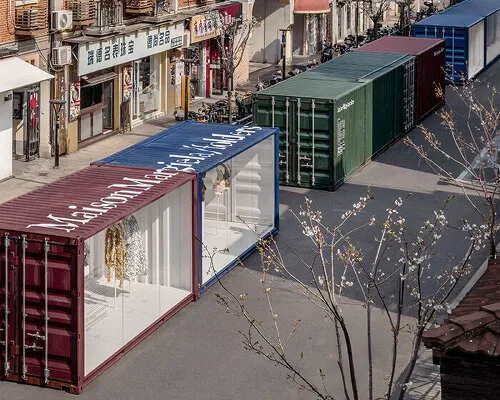
Following a runway presentation in Shanghai, Margiela has teamed up with the celebrated architecture and design firm OMA and its research arm AMO to expand the moment into something much bigger - a four-city project that uses repurposed shipping containers as its architectural backbone. As reported by Designboom, the exhibition framing draws on the industrial rawness of those steel boxes to create an immersive experience that feels deeply Margiela: structured yet subversive, deliberate yet deconstructed.
Why shipping containers? Why not.
The choice of shipping containers isn't just an aesthetic flex - though it absolutely lands as one. There's something genuinely poetic about using vessels designed for global trade as the framework for a luxury fashion exhibition touring across one of the world's most dynamic consumer markets. It nods to movement, to transit, to the idea that fashion itself is always in motion between cultures and contexts.
OMA/AMO has long been a go-to collaborator for brands that want their physical spaces to do more than just look pretty. The firm, founded by architect Rem Koolhaas, brings a conceptual rigor to spatial design that matches Margiela's own obsessive attention to ideas over spectacle. Together, they tend to produce environments that make you think as much as they make you feel.
Fashion as a four-city conversation
Expanding beyond a single runway show into a multi-city exhibition format is a smart move for a brand looking to deepen its presence in China rather than just passing through. It transforms what could have been a one-night event into an ongoing cultural conversation - giving more audiences across different cities the chance to engage with the work on their own terms.
For Margiela, a house that has always valued the idea of fashion as art and culture rather than mere product, this kind of extended, architecturally considered presentation makes complete sense. The container structure gives each installation a visual consistency while still allowing the work to breathe differently depending on its context and location.
It's the kind of project that reminds you why the intersection of fashion and architecture is so compelling when both parties are genuinely committed to ideas. Not every brand can pull this off. Margiela, with OMA/AMO in its corner, absolutely can.