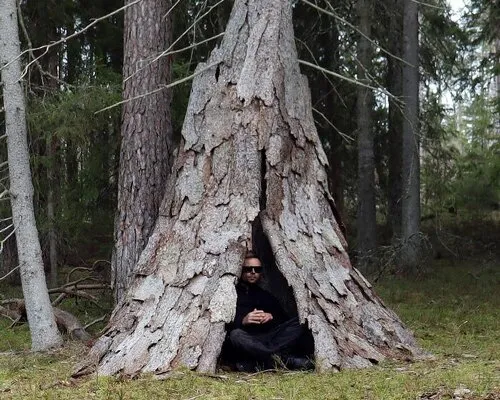
What if your house wasn't just near nature, but physically wrapped around it? That's exactly the vibe Swedish architect Ulf Mejergren is serving with his latest project - a small forest hut in Sweden that grows around a living spruce tree like the world's most poetic bear hug.
Bark beetles accidentally made this possible
Here's where it gets nerdy-cool. The bark used to construct the shelter wasn't harvested in any destructive way. Mejergren collected loose bark from trees already damaged by bark beetles - the invasive little nightmares currently tearing through Scandinavian forests at an alarming rate. So in a weird twist of ecological fate, the same pest causing widespread forest destruction ended up supplying the raw material for something genuinely beautiful.
The result is a structure that feels less like a building and more like the forest decided to fold in on itself and make you a room. The bark wraps and layers around the living spruce, creating an enclosure that looks like it sprouted organically from the ground rather than being designed by a human with a pencil and a portfolio.
Why this matters beyond the Instagram potential
It would be easy to dismiss this as a fancy art installation for people who own linen trousers and use the word "liminal" unironically. But there's something genuinely important happening here. Mejergren is asking a real question about how we build - specifically, whether architecture has to be extractive, or whether it can work with what already exists, including the living systems already on site.
Using salvaged bark, building around rather than through an existing tree, and creating a structure with a feather-light footprint - these aren't just aesthetic choices. They're a quiet argument about what thoughtful design could look like when we stop treating forests as raw material waiting to be processed.
According to Designboom, the hut essentially grows from its site rather than being imposed on it, which is exactly the kind of sentence that sounds like pretentious architect-speak but in this case is actually just... accurate.
The bigger picture
There's a certain irony in the fact that bark beetle devastation - one of the more visible symptoms of climate-disrupted ecosystems in northern Europe - becomes, in Mejergren's hands, a building material for something quietly hopeful. It won't solve deforestation. It won't stop the beetles. But it does prove that working with damaged landscapes rather than ignoring them can produce something worth paying attention to.
Plus, honestly? A little hut wrapped in silver-grey spruce bark, nestled around a living tree in the Swedish wilderness? That's the most compelling real estate listing we've seen all year.