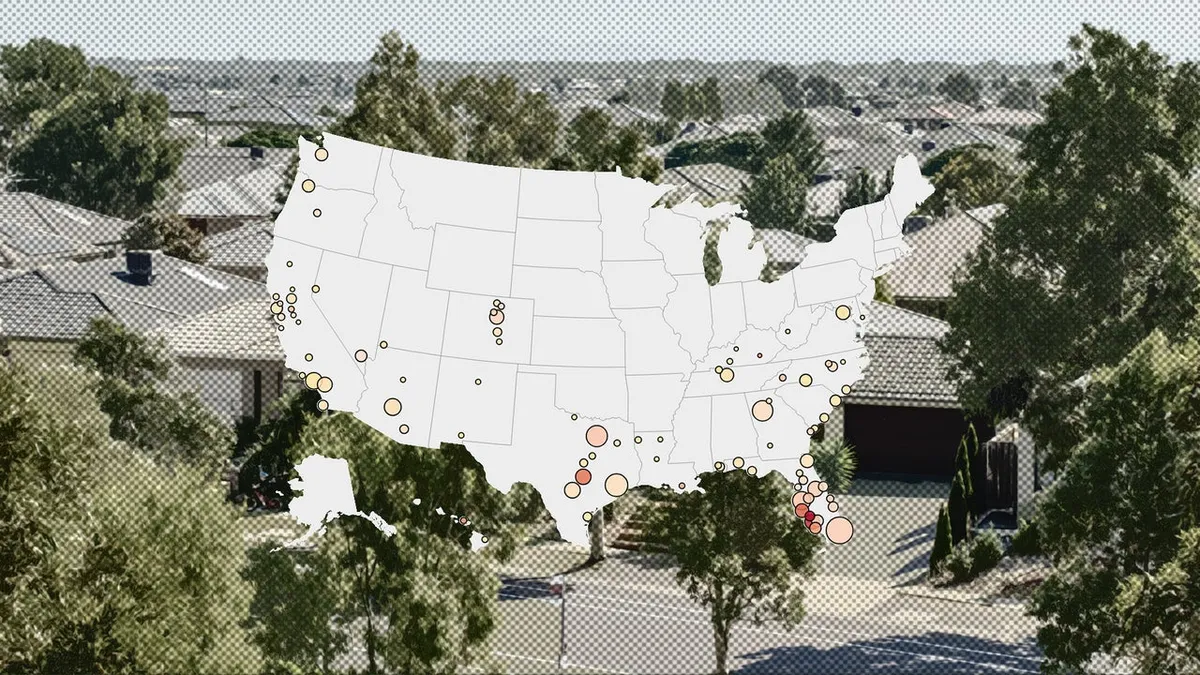
Here's the thing about national housing market statistics: they're basically the economic equivalent of "on average, everyone has one testicle." Technically accurate. Deeply useless for most people.
So while the headline number from Zillow's Home Value Index shows U.S. home prices up a modest +0.8% year-over-year between March 2025 and March 2026, that cozy little figure is doing a lot of heavy lifting to hide some genuinely chaotic local realities - according to analysis shared by ResiClub's Lance Lambert via Fast Company.
The number that actually matters
That +0.8% national growth figure is already a slowdown from the +1.2% rate recorded a year earlier. And if you think that sounds underwhelming, buckle up: national year-over-year growth actually hit a low of basically zero (-0.01%) back in August 2025. It has since stabilized, but "stabilized near zero" is not exactly the victory lap housing bulls were hoping for.
Meanwhile, prices are outright falling in 89 housing markets. Not slowing. Not plateauing. Falling.
Why is this happening?
The short version: the pandemic-era housing frenzy sent prices absolutely feral in certain markets, and gravity is now doing what gravity does. Some cities overshot their fundamentals so aggressively that even in a tight inventory environment, buyers are simply refusing to play along at those prices anymore.
Add in stubbornly high mortgage rates that have kept monthly payments at near-historic pain levels, and you've got a buyer pool that is, to put it diplomatically, not exactly champing at the bit.
The first half of 2025 saw the number of major markets experiencing price declines expand - meaning this isn't a quirky blip in one weird Sun Belt metro. It's a pattern.
What this means for you, specifically
If you're a buyer, the words "prices falling in 89 markets" should make your ears perk up. This is exactly the kind of environment where patience and local research actually pay off rather than the FOMO-fueled, waive-everything chaos of 2021.
If you're a seller, the national average is not your friend right now - it's covering for the fact that your specific market might be softening faster than you'd like to admit.
And if you're a homeowner just hoping your asset doesn't quietly deflate while you're not looking? Well. Maybe check which list your city is on.
The housing market in 2025 isn't crashing nationally - but it is quietly fracturing at the local level in ways the big averages simply cannot capture. As always, real estate's oldest cliche remains annoyingly correct: it's all about location.